
2026 Trading Psychology Traps: Why Good Strategies Fail in Practice
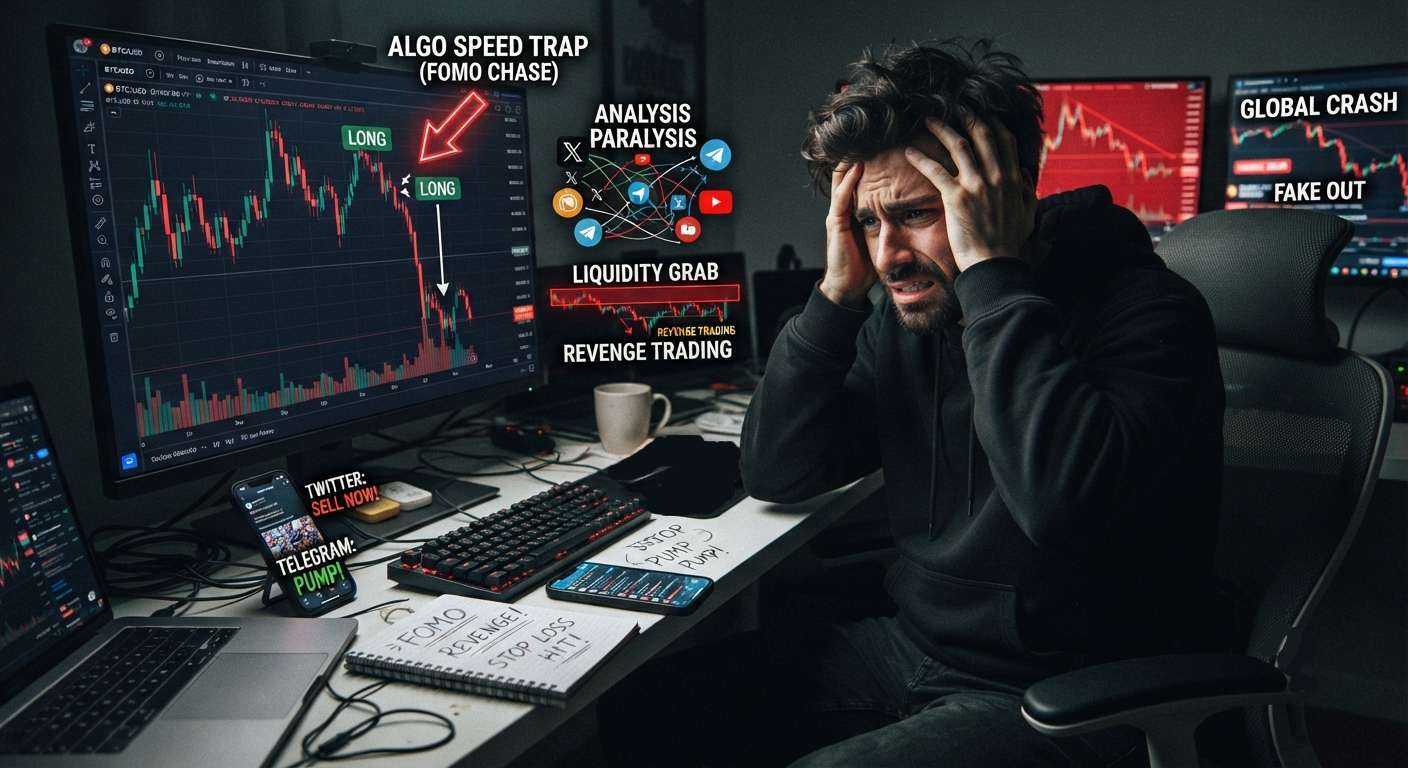
Ever had that happen where you spend hours staring at the charts, backtest your strategy to the exact point, your indicators line up right where they should, and the risk-to-reward looks bulletproof—only for the market to flip the second you enter the trade?
Right after that, you start doubting your whole system, messing with your parameters, and worst of all, falling headfirst into revenge trading.
If that sounds familiar, you’re definitely not alone. Trading in the fast-paced markets of 2026 isn’t really about a lack of technical skills anymore; the real enemy is the psychological friction between a solid plan and how we actually execute it under pressure.
Let’s look at where our brains mess up and how to dodge these traps.
1. The Algorithmic Speed Trap (FOMO & Panic Chasing)
Markets move way faster than they used to. Between high-frequency trading bots and instant global news updates, price can rip a massive pump or a flash crash in a matter of seconds.
The Trap: Seeing a coin or asset suddenly spike triggers that heavy fear of missing out (FOMO). You throw your entry rules out the window, chase the green candle, and end up buying right into resistance.
The Reality: Your strategy wasn’t broken—your discipline just collapsed. Chasing price without confirmation turns a calculated trade into a straight-up gamble.
The Fix: Stop staring at every single ticking candle. Rely instead on objective, rule-based alerts. Having your entry and exit points mapped out before you click buy takes the emotional panic out of the equation.
2. Analysis Paralysis in the Information Age
Traders today are constantly buried under an avalanche of data: X (Twitter) threads, Telegram signal rooms, YouTube breakdowns, and a dozen conflicting sentiment indicators.
The Trap: When you try to reconcile five different opinions with your own charts, you hit a wall of analysis paralysis. By the time you actually decide, the move is long gone, or you get so second-hand stressed that you bail out of a winning position way too early.
The Reality: More information does not equal more profit. Most of the time, it just creates noise and self-doubt.
The Fix: Filter out the noise. Stick to a clean, reliable system or a trusted set of indicators that give you direct, real-time signals without the guesswork.
3. Revenge Trading After Fake Breakouts
Fake signals and liquidity grabs have gotten super sophisticated. Market makers love sweeping liquidity right above major highs or below key lows just to reverse hard.
The Trap: Getting stopped out by a sudden liquidity sweep hurts your ego bad. You get pissed, jump right back in with a heavier position size to “make your money back.” That’s revenge trading, and it usually wipes your balance clean in minutes.
The Reality: Taking losses is just the baseline cost of doing business in this market. Trying to emotionally get even with the market is a game you’re guaranteed to lose.
The Fix: Set an ironclad rule: two stops in a row means you close the charts and walk away for the day. Your capital and your mental peace are worth way more than a grudge against the ticker.
4. The Illusion of Control Through Constant Tweaking
Because modern platforms let you customize literally every parameter, color, and moving average, traders easily get sucked into an endless loop of optimization.
The Trap: Every time a trade goes red, you go tinkering with your strategy settings. You spend hours messing with indicators, hoping you’ll stumble on some “magic formula.”
The Reality: Curve-fitting a strategy to past data practically guarantees it will crash and burn in live conditions. A simple, consistent strategy executed with actual discipline will always beat a complex Frankenstein system that changes every single week.
Final Thoughts: Let Systems Do the Heavy Lifting
The best traders out there don’t succeed because they’re fearless robots; they succeed because they’ve built systems that don’t rely on pure willpower.
Whether you’re trading crypto, forex, or stocks, real longevity comes down to consistency. Trust your framework, manage your risk like your account depends on it—because it does—and let structured indicators and alerts handle the heavy lifting so you don’t have to fight your own head every single day.